

Case Study
·
#03
California Break Compliance
Turning complex legislation into a scalable compliance capability
ROLE -
Staff Product Designer
TEAMS -
Product · Engineering · Implementation · Strategy
FOCUS -
Compliance · Policy logic · Worker data capture · Progressive disclosure

01 — DEFINE
Context & opportunity
Translating complex legislation into a usable workday experience

California meal and rest break rules depend on how long someone works, when breaks occur, and whether breaks are taken, skipped or waived.
The challenge wasn't simply to display the rules. The product needed to determine:
- Which breaks a worker was entitled to.
- When they should take them.
- What actually happened.
- What information needed to be recorded.
- How much interaction was practical in the working environment.
These requirements could also vary across companies, sectors, jurisdictions and working environments.
The design opportunity
Turn complex break legislation into a flexible, worker-friendly experience.
Create a model that could determine break entitlements, capture what actually happened, and adapt to different shift patterns, environments, organisations and regulatory requirements.
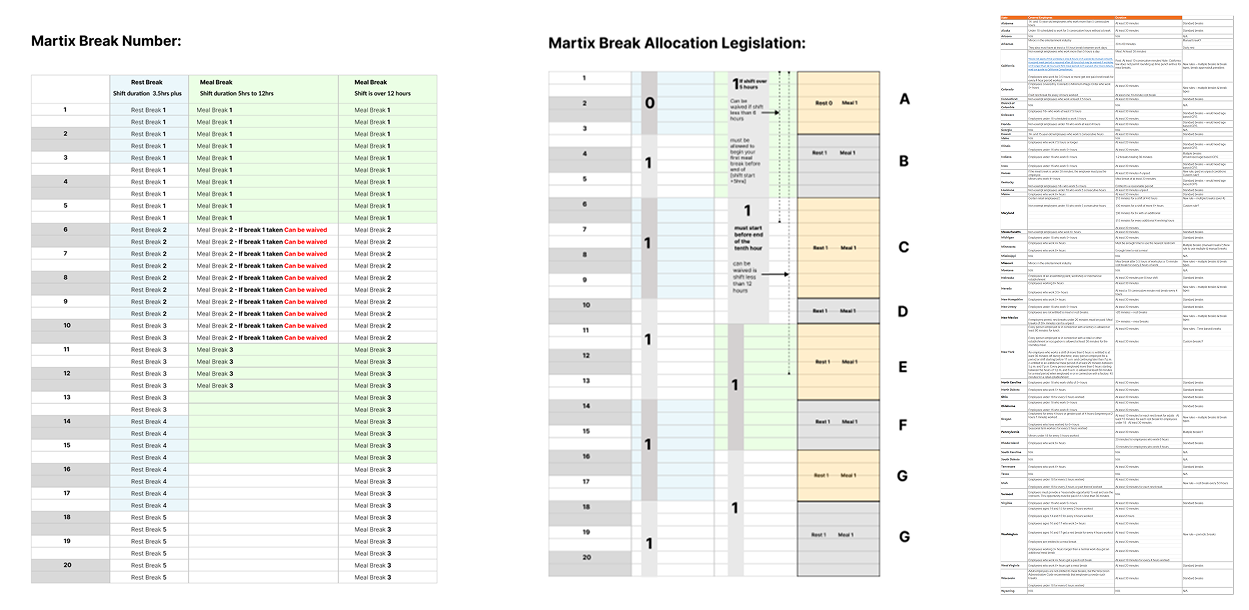
Translating legislation into core system rule
SCALABLE FOUNDATION
“One model. Many rules.”
Separating policy logic, configuration and worker interaction to support different organisations and jurisdictions
02 — Define
The challenge
Complex rules. Simple interactions.
The system needed to understand the rules before asking the worker to act.The first challenge was separating what the system could determine from what only the worker could confirm.
The system could determine
- Break entitlement
- Expected timing
- Applicable rules
- Compliance status
The worker needed to confirm
- Whether a break actually happened
- When it happened
- Whether it was skipped, delayed or interrupted
- Any relevant exception
This distinction became the foundation for the interaction model.
Shift flows
Mapping shift flows and expected behaviour patterns
03 — Model
A reusable compliance capability
From legislation and rules to simple, auditable worker interactions
The model needed to accommodate different shift lengths, break patterns and types, missed or waived breaks, company-specific configurations and regulatory variations.
Break rules and requirements
The legislation and company policies that apply

Entitlement and timing calculations
Determine which breaks are due and when
Expected breaks
Establish what should happen during the shift
Actual breaks and exceptions
Capture what happened, including missed, delayed or interrupted breaks
Compliance records and evidence
Compare expected and actual information to assess compliance and support audit requirements.
The model needed to accommodate different shift lengths and break patterns, multiple break types, missed or waived breaks, company-specific configurations and regulatory variations.
The design decision was to separate the underlying rules from the worker interaction — creating a foundation that could handle complexity without passing it on to the user.
04 — EXPLORE - HUMAN-CENTRED DESIGN
Designing for real work environment
Designing around real-world behaviours
The experience needed to work within the realities of the workplace, where workers might have limited time to interact with a shared device and routines could be interrupted.
What I learned
Dwell time varied.
Some workers only spent short periods near a device.
Shared devices
Workers may use fixed devices shared across the workforce
Shift patterns
Start, finish and break patterns can vary
Workplace interruptions
Tasks and priorities can interrupt normal routines
How it shaped the design
Fast interactions
Keep the core shift interaction quick and predictable
Simple access
Make the essential interaction easy to complete
Flexible timing
Allow updates when circumstances change
Time-bounded updates
Allow corrections within a defined window
The core interaction needed to be quick and predictable, with enough flexibility to handle real-world exceptions.
HUMAN-CENTRED DESIGN
“Designing for the reality of work”
Shaping the experience around real-world behaviours
05 — ADAPT
One model. Different realities.
Designing flexibility into the product, not around it.
Rather than creating separate experiences for every scenario, the underlying model could adapt to:
Regulations

Different jurisdictions and requirements.
Organisations
Company policies and configurations.
Shifts
Different durations, patterns and entitlements.
Environments
Different devices and opportunities to interact.
The experience stays familiar. The rules underneath can change.
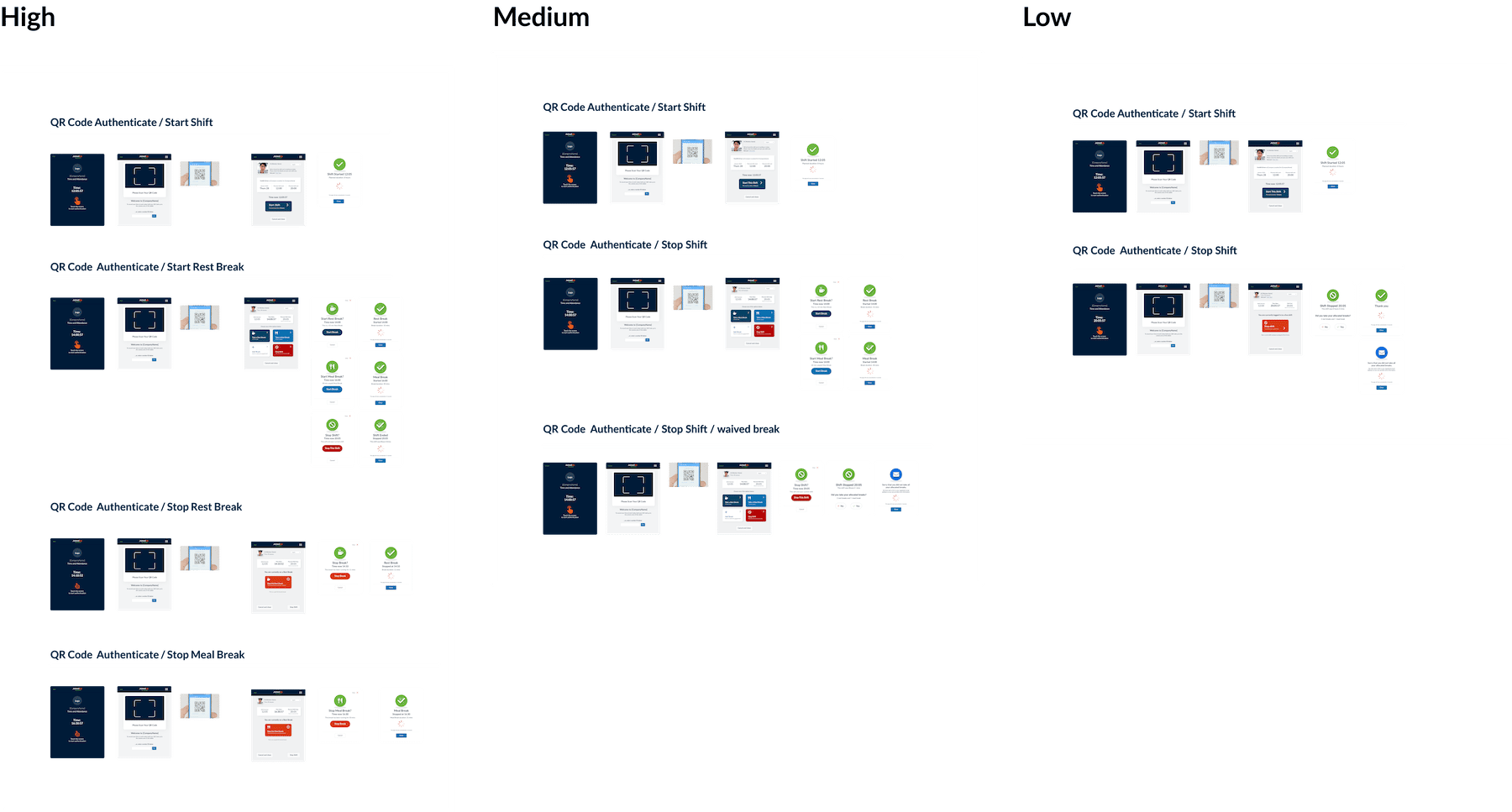
Screen flows exploring high- and low-touch interaction models
SCALABILITY
“Design once, adapt to variation”
One model. Different rules and realities.
06 — Refine
The experience
Making complexity visible only when it matters
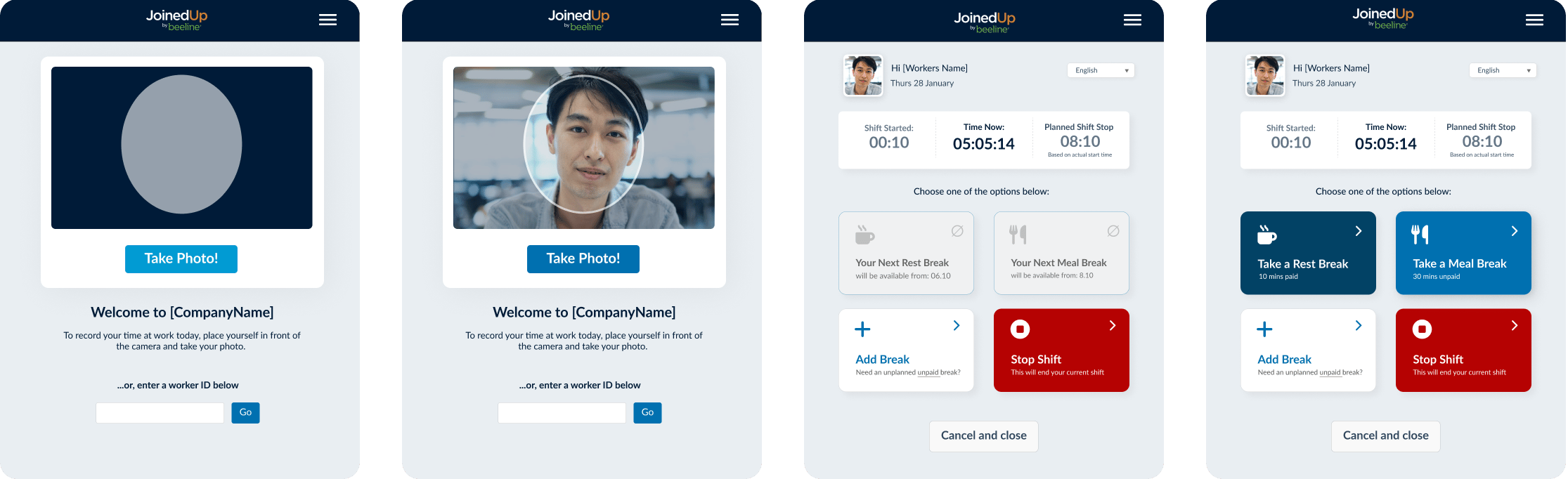
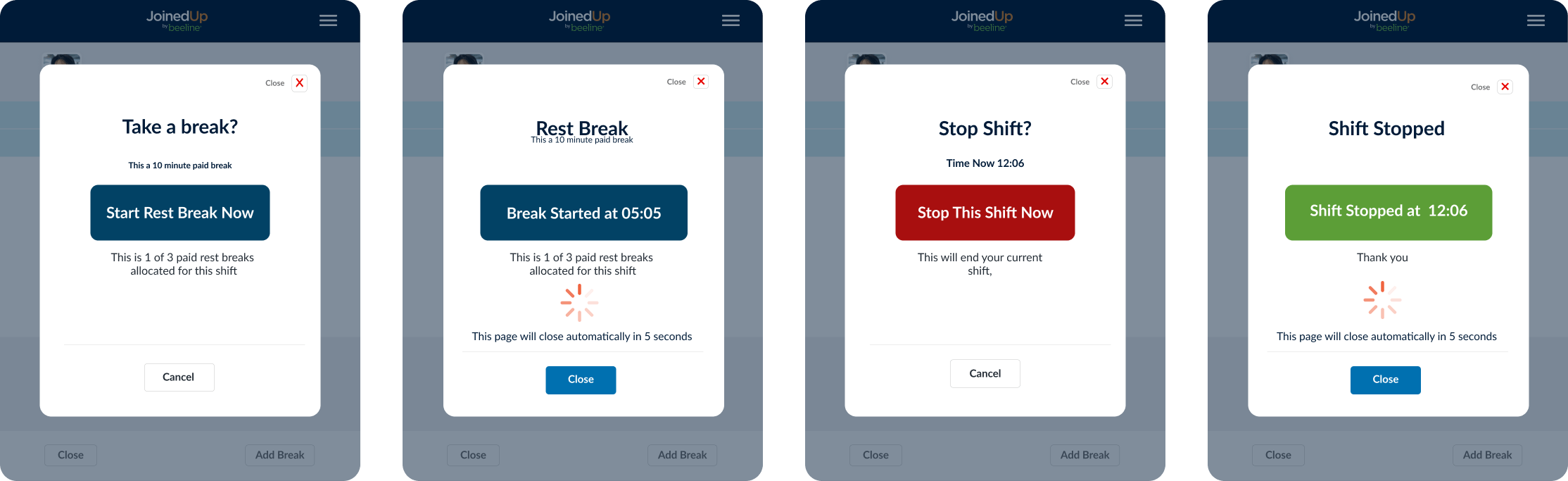
The product needed to surface the right information at the right moment, without requiring workers to interpret the underlying rules.
Knowing what’s expected
Show the relevant break status and timing
Recording a break
Capture what actually happened.
Handling a change
Support missed, delayed or interrupted breaks.
Providing the right details
Capture the additional context required for compliance without adding unnecessary friction.
07 — OUTOCME
Outcome
A reusable compliance capability
The work established a product model for turning complex compliance rules into simple, auditable worker interactions.
It connected regulatory requirements, product logic, worker behaviour and compliance evidence as parts of one system.
Consistency
A shared logic for determining entitlements and assessing what happened.
Adaptability
A model designed to accommodate different regulations, organisations and shift patterns.
Practicality
An interaction shaped around the realities of the working environment.
Traceability
Capturing the information needed to support compliance assessment and audit.
This established a foundation for handling changes in rules and working conditions through the underlying model, rather than treating every new scenario as a separate interaction-design problem.
The value was in connecting the parts — not just simplifying the interface.

08 — REFLECt
Design takeaway
Complexity in the system. Clarity in the experience.
Good compliance UX isn't about exposing every rule. It's about understanding the rules, capturing the right evidence, and asking users only for what they need to provide.
By separating what the system could determine from what the worker needed to confirm, the design balanced regulatory requirements with the realities of the workplace.
The strongest experiences don't transfer complexity to the people using them. They put it where it belongs.


Home
Work
About
Contact
Case Study
·
#03
California Break Compliance
Turning complex legislation into a scalable compliance capability
ROLE -
Staff Product Designer
TEAMS -
Product · Engineering · Implementation · Strategy
FOCUS -
Compliance · Policy logic · Worker data capture · Progressive disclosure
01 — DEFINE
Context & opportunity
Translating complex legislation into a usable workday experience

California meal and rest break rules depend on how long someone works, when breaks occur, and whether breaks are taken, skipped or waived.
The challenge wasn't simply to display the rules. The product needed to determine:
- Which breaks a worker was entitled to.
- When they should take them.
- What actually happened.
- What information needed to be recorded.
- How much interaction was practical in the working environment.
These requirements could also vary across companies, sectors, jurisdictions and working environments.
The design opportunity
Turn complex break legislation into a flexible, worker-friendly experience.
Create a model that could determine break entitlements, capture what actually happened, and adapt to different shift patterns, environments, organisations and regulatory requirements.
Translating legislation into core system rule
SCALABLE FOUNDATION
“One model. Many rules.”
Separating policy logic, configuration and worker interaction to support different organisations and jurisdictions
02 — Define
The challenge
Complex rules. Simple interactions.
The system needed to understand the rules before asking the worker to act.The first challenge was separating what the system could determine from what only the worker could confirm.
The system could determine
- Break entitlement
- Expected timing
- Applicable rules
- Compliance status
The worker needed to confirm
- Whether a break actually happened
- When it happened
- Whether it was skipped, delayed or interrupted
- Any relevant exception
This distinction became the foundation for the interaction model.
Shift flows
Mapping shift flows and expected behaviour patterns
03 — Model
A reusable compliance capability
From legislation and rules to simple, auditable worker interactions
The model needed to accommodate different shift lengths, break patterns and types, missed or waived breaks, company-specific configurations and regulatory variations.
Break rules and requirements
The legislation and company policies that apply
Entitlement and timing calculations
Determine which breaks are due and when
Expected breaks
Establish what should happen during the shift
Actual breaks and exceptions
Capture what happened, including missed, delayed or interrupted breaks
Compliance records and evidence
Compare expected and actual information to assess compliance and support audit requirements.
The model needed to accommodate different shift lengths and break patterns, multiple break types, missed or waived breaks, company-specific configurations and regulatory variations.
The design decision was to separate the underlying rules from the worker interaction — creating a foundation that could handle complexity without passing it on to the user.
04 — EXPLORE - HUMAN-CENTRED DESIGN
Designing for real work environment
Designing around real-world behaviours
The experience needed to work within the realities of the workplace, where workers might have limited time to interact with a shared device and routines could be interrupted.
What I learned
Dwell time varied.
Some workers only spent short periods near a device.
Shared devices
Workers may use fixed devices shared across the workforce
Shift patterns
Start, finish and break patterns can vary
Workplace interruptions
Tasks and priorities can interrupt normal routines
How it shaped the design
Fast interactions
Keep the core shift interaction quick and predictable
Simple access
Make the essential interaction easy to complete
Flexible timing
Allow updates when circumstances change
Time-bounded updates
Allow corrections within a defined window
The core interaction needed to be quick and predictable, with enough flexibility to handle real-world exceptions.
HUMAN-CENTRED DESIGN
“Designing for the reality of work”
Shaping the experience around real-world behaviours
05 — ADAPT
One model. Different realities.
Designing flexibility into the product, not around it.
Rather than creating separate experiences for every scenario, the underlying model could adapt to:
Regulations

Different jurisdictions and requirements.
Organisations
Company policies and configurations.
Shifts
Different durations, patterns and entitlements.
Environments

Different devices and opportunities to interact.
The experience stays familiar. The rules underneath can change.
Screen flows exploring high- and low-touch interaction models
SCALABILITY
“Design once, adapt to variation”
One model. Different rules and realities.
06 — Refine
The experience
Making complexity visible only when it matters
The product needed to surface the right information at the right moment, without requiring workers to interpret the underlying rules.
Knowing what’s expected
Show the relevant break status and timing
Recording a break
Capture what actually happened.
Handling a change
Support missed, delayed or interrupted breaks.
Providing the right details

Capture the additional context required for compliance without adding unnecessary friction.
07 — OUTOCME
Outcome
A reusable compliance capability
The work established a product model for turning complex compliance rules into simple, auditable worker interactions.
It connected regulatory requirements, product logic, worker behaviour and compliance evidence as parts of one system.
Consistency
A shared logic for determining entitlements and assessing what happened.
Adaptability
A model designed to accommodate different regulations, organisations and shift patterns.
Practicality
An interaction shaped around the realities of the working environment.
Traceability
Capturing the information needed to support compliance assessment and audit.
This established a foundation for handling changes in rules and working conditions through the underlying model, rather than treating every new scenario as a separate interaction-design problem.
The value was in connecting the parts — not just simplifying the interface.
08 — REFLECt
Design takeaway
Complexity in the system. Clarity in the experience.
Good compliance UX isn't about exposing every rule. It's about understanding the rules, capturing the right evidence, and asking users only for what they need to provide.
By separating what the system could determine from what the worker needed to confirm, the design balanced regulatory requirements with the realities of the workplace.
The strongest experiences don't transfer complexity to the people using them. They put it where it belongs.
Home
Work
About
Contact
Case Study
·
#03
California Break Compliance
Turning complex legislation into a scalable compliance capability
ROLE -
Staff Product Designer
TEAMS -
Product · Engineering · Implementation · Strategy
FOCUS -
Compliance · Policy logic · Worker data capture · Progressive disclosure
01 — DEFINE
Context & opportunity
Translating complex legislation into a usable workday experience

California meal and rest break rules depend on how long someone works, when breaks occur, and whether breaks are taken, skipped or waived.
The challenge wasn't simply to display the rules. The product needed to determine:
- Which breaks a worker was entitled to.
- When they should take them.
- What actually happened.
- What information needed to be recorded.
- How much interaction was practical in the working environment.
These requirements could also vary across companies, sectors, jurisdictions and working environments.
The design opportunity
Turn complex break legislation into a flexible, worker-friendly experience.
Create a model that could determine break entitlements, capture what actually happened, and adapt to different shift patterns, environments, organisations and regulatory requirements.
Translating legislation into core system rule
SCALABLE FOUNDATION
“One model. Many rules.”
Separating policy logic, configuration and worker interaction to support different organisations and jurisdictions
02 — Define
The challenge
Complex rules. Simple interactions.
The system needed to understand the rules before asking the worker to act.The first challenge was separating what the system could determine from what only the worker could confirm.
The system could determine
- Break entitlement
- Expected timing
- Applicable rules
- Compliance status
The worker needed to confirm
- Whether a break actually happened
- When it happened
- Whether it was skipped, delayed or interrupted
- Any relevant exception
This distinction became the foundation for the interaction model.
Shift flows
Mapping shift flows and expected behaviour patterns
03 — Model
A reusable compliance capability
From legislation and rules to simple, auditable worker interactions
The model needed to accommodate different shift lengths, break patterns and types, missed or waived breaks, company-specific configurations and regulatory variations.
Break rules and requirements
The legislation and company policies that apply
Entitlement and timing calculations
Determine which breaks are due and when
Expected breaks
Establish what should happen during the shift
Actual breaks and exceptions
Capture what happened, including missed, delayed or interrupted breaks
Compliance records and evidence
Compare expected and actual information to assess compliance and support audit requirements.
The model needed to accommodate different shift lengths and break patterns, multiple break types, missed or waived breaks, company-specific configurations and regulatory variations.
The design decision was to separate the underlying rules from the worker interaction — creating a foundation that could handle complexity without passing it on to the user.
04 — EXPLORE - HUMAN-CENTRED DESIGN
Designing for real work environment
Designing around real-world behaviours
The experience needed to work within the realities of the workplace, where workers might have limited time to interact with a shared device and routines could be interrupted.
What I learned
Dwell time varied.
Some workers only spent short periods near a device.
Shared devices
Workers may use fixed devices shared across the workforce
Shift patterns
Start, finish and break patterns can vary
Workplace interruptions
Tasks and priorities can interrupt normal routines
How it shaped the design
Fast interactions
Keep the core shift interaction quick and predictable
Simple access
Make the essential interaction easy to complete
Flexible timing
Allow updates when circumstances change
Time-bounded updates
Allow corrections within a defined window
The core interaction needed to be quick and predictable, with enough flexibility to handle real-world exceptions.
HUMAN-CENTRED DESIGN
“Designing for the reality of work”
Shaping the experience around real-world behaviours
05 — ADAPT
One model. Different realities.
Designing flexibility into the product, not around it.
Rather than creating separate experiences for every scenario, the underlying model could adapt to:
Regulations

Different jurisdictions and requirements.
Organisations
Company policies and configurations.
Shifts
Different durations, patterns and entitlements.
Environments
Different devices and opportunities to interact.
The experience stays familiar. The rules underneath can change.
Screen flows exploring high- and low-touch interaction models
SCALABILITY
“Design once, adapt to variation”
One model. Different rules and realities.
06 — Refine
The experience
Making complexity visible only when it matters
The product needed to surface the right information at the right moment, without requiring workers to interpret the underlying rules.
Knowing what’s expected
Show the relevant break status and timing
Recording a break
Capture what actually happened.
Handling a change
Support missed, delayed or interrupted breaks.
Providing the right details

Capture the additional context required for compliance without adding unnecessary friction.
07 — OUTOCME
Outcome
A reusable compliance capability
The work established a product model for turning complex compliance rules into simple, auditable worker interactions.
It connected regulatory requirements, product logic, worker behaviour and compliance evidence as parts of one system.
Consistency
A shared logic for determining entitlements and assessing what happened.
Adaptability
A model designed to accommodate different regulations, organisations and shift patterns.
Practicality
An interaction shaped around the realities of the working environment.
Traceability
Capturing the information needed to support compliance assessment and audit.
This established a foundation for handling changes in rules and working conditions through the underlying model, rather than treating every new scenario as a separate interaction-design problem.
The value was in connecting the parts — not just simplifying the interface.
08 — REFLECt
Design takeaway
Complexity in the system. Clarity in the experience.
Good compliance UX isn't about exposing every rule. It's about understanding the rules, capturing the right evidence, and asking users only for what they need to provide.
By separating what the system could determine from what the worker needed to confirm, the design balanced regulatory requirements with the realities of the workplace.
The strongest experiences don't transfer complexity to the people using them. They put it where it belongs.